



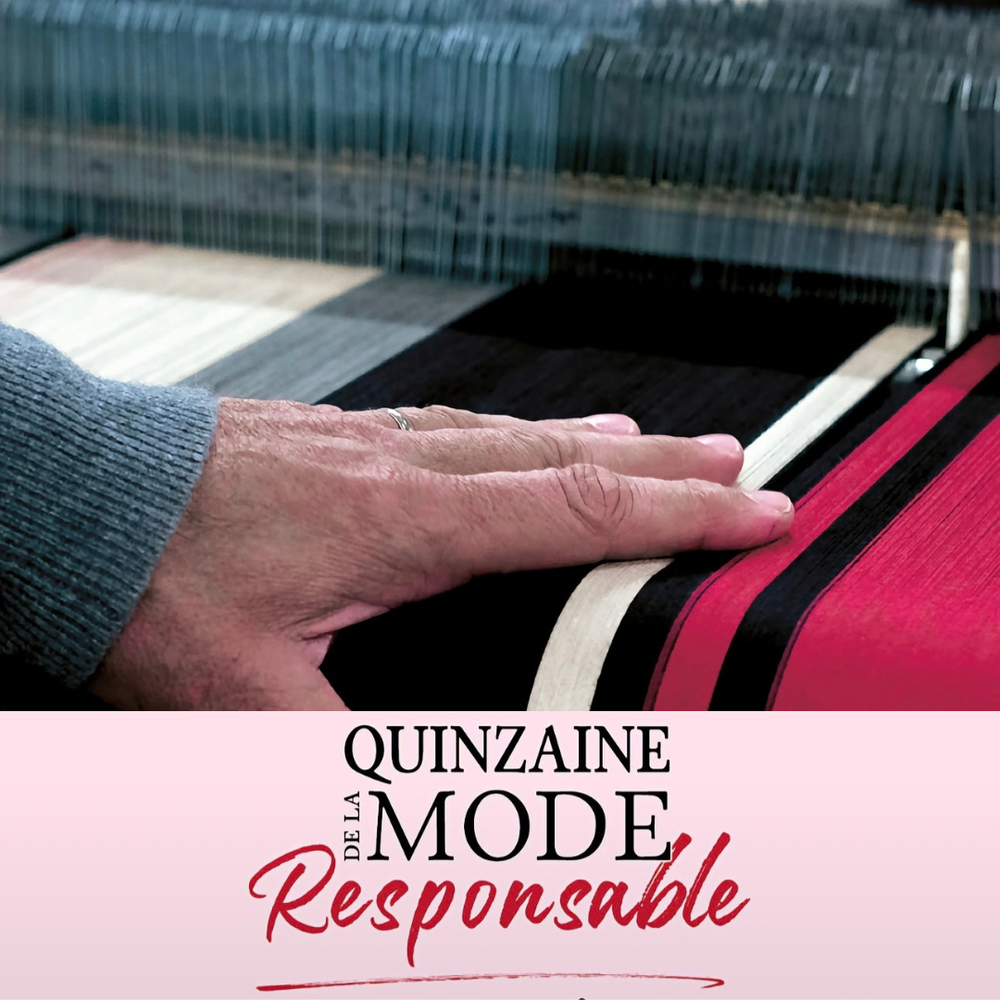
Responsible Fashion Fortnight: make less, make it further, choose better
For two weeks, the Responsible Fashion Fortnight invites us to look at our wardrobe differently. To question the origin of our clothes, how they are made, the materials they are composed of, and the expertise hidden behind them.
At Maison Broussaud, these questions guide us far beyond a fortnight.
Since 1938, our socks have been made in our workshop in Les Cars, in Haute-Vienne. A choice that allows us to preserve French textile expertise, to stay close to production, and to know exactly where and how our products are made.
On the occasion of the Responsible Fashion Fortnight, we are once again opening the doors of our workshop.
What is the Responsible Fashion Fortnight?
The Responsible Fashion Fortnight is an opportunity to highlight a different way of imagining, making, and consuming fashion, initiated by the Nouvelle-Aquitaine region.
Behind a pair of socks, a sweater, or a shirt lies an entire chain: raw materials, suppliers, workshops, machines, and above all, the men and women who possess expertise.
Taking an interest in more responsible fashion also means taking an interest in the history of the product you buy.
Where was it made? Under what conditions? With what materials? Is it designed to last? Can you identify those who made it?
Simple questions, but they change the way we look at a label.
What does manufacturing in France mean for Maison Broussaud?
For us, the answer lies in one place: Les Cars, in Haute-Vienne.
This is where our story began in 1938. And it is still here, more than 85 years later, that our collections come to life.
In our factory, threads gradually become socks. The machines are programmed, the models knitted, then checked and prepared by our teams.
Maintaining this production in France above all allows us to retain control over our manufacturing and to keep alive skills developed over generations.
Because manufacturing in France is not just a mention on a label.
It is trades, gestures, machines, and knowledge of knitwear that are passed down and evolve.
Why preserve French textile expertise?
Because expertise cannot be recreated in a few weeks.
Understanding a knitting trade, mastering thread tension, transforming a drawing into a pattern, adjusting a stitch, or achieving the right finish takes time and experience.
Since 1938, our factory has evolved without renouncing what makes it unique.
The machines change. The collections too. The patterns become more precise, the colors follow today's wardrobe, and new techniques gradually join the workshop.
But the gesture remains.
Preserving French textile manufacturing also means allowing these skills to continue to exist tomorrow.
How to recognize a sock made in a more responsible way?
There is no single criterion that can summarize the responsibility of a product on its own.
Several elements can, however, guide the choice.
The place of manufacture first allows you to know where the product was actually made. The composition then provides information about the fibers used. Certifications and labels, meanwhile, provide additional guarantees according to specific criteria.
At Maison Broussaud, our factory notably benefits from the Living Heritage Company (EPV) and Guaranteed French Origin (OFG) labels. Our products are also certified OEKO-TEX® STANDARD 100 CQ 1276/2 IFTH, which regulates the presence of harmful substances in textiles.
This is all the information that allows you to look beyond the pattern or color of a pair.
Does responsible fashion also mean longevity?
Choosing better also means choosing pieces that you will want to wear for a long time.
More responsible fashion does not necessarily mean giving up pleasure, colors, or whimsy. On the contrary, it can start with a very simple question: will I still want to wear this piece in several seasons?
This is a reflection we keep in mind when we imagine our collections.
A fox can come back from one season to the next. A beautiful pair of navy socks lasts through the years. Lisle thread keeps its place in the men's wardrobe. Ribs, stripes, or floral patterns are reinterpreted rather than systematically replaced.
Collections move forward, some essentials remain.
Is buying French enough to consume responsibly?
French manufacturing is an interesting criterion, notably because it allows you to support jobs and expertise in the country. But it does not summarize, on its own, all the dimensions of responsible fashion.
The material, the quality of manufacturing, the product's lifespan, its maintenance, and the quantity we buy also matter.
This is why we prefer to talk about more informed choices rather than a perfect product.
Look at the label. Know the workshop. Understand the material. Maintain your clothes properly. Buy a pair that you will really wear.
Responsibility is also built in these small gestures.
On the occasion of this Responsible Fashion Fortnight, we could have simply talked about French manufacturing.
We prefer to show you what it represents.
A workshop in Haute-Vienne. Knitting machines in motion. Rows of thread spools. Drawings that become stitches. Teams that check, adjust, and start over when necessary.
And a French factory that has continued, since 1938, to keep its expertise alive while looking toward tomorrow.
Because a sock may seem like a small everyday object.
But when you take the time to look at how it is made, it tells much more than it seems.
Discover our video series with UPTHC:


